
There is something immediately unsettling about the coastline in Fishbrain.
A shoreline covered in dead fish should be disturbing enough on its own, but writer-director Max Vanderspuy uses the setting to create something much more intimate. The isolation, overcast skies and seemingly endless coastline create a growing sense that something isn’t quite right.
Interestingly, that’s where the idea for Fishbrain began.
Vanderspuy told me the film first came to him in a dream, centred around a coastline covered in dead fish. He was drawn to the eerie potential of the setting, particularly the feeling that a coastline can become strangely unsettling when the sun disappears.
That atmosphere became an important part of Fishbrain, a new body horror short from London-based writer-director Vanderspuy. The film stars BAFTA Children’s Award-winner Chloe Lea, John Henshaw and Karren Winchester.
But beneath the film’s striking imagery and body horror is something much more human.
When care becomes captivity
Vanderspuy’s previous short, Recursive Dreams, explored themes surrounding family, so Fishbrain became a natural continuation of an interest he already had in complicated family relationships.
The major difference this time was the way he chose to explore them.
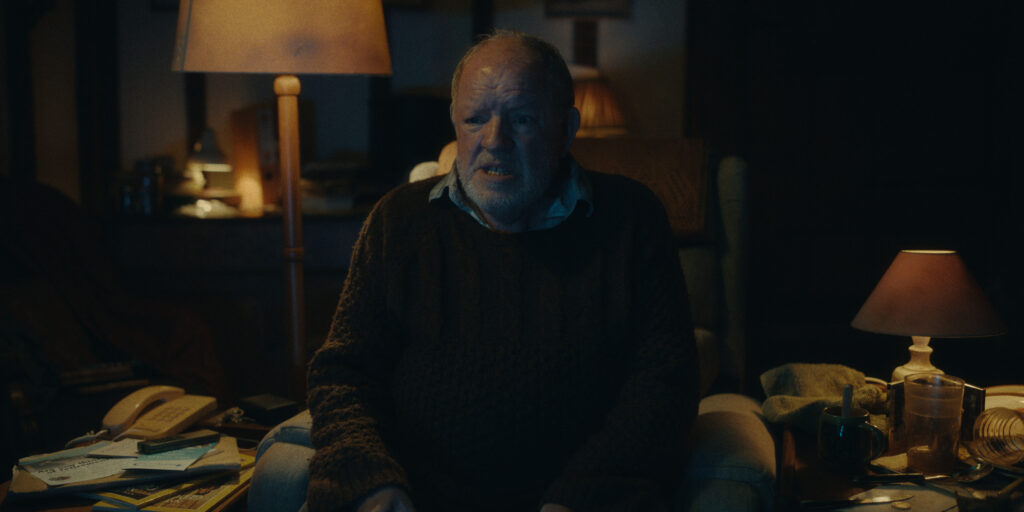
Vanderspuy has always loved horror and knew early on that Fishbrain would be a body horror film. The film draws inspiration from body horror classics such as The Thing, Under the Skin and Eraserhead, but the horror isn’t simply there to unsettle the audience.
It’s there to visualise what the characters are feeling.
At the centre of Fishbrain is Ori and her relationship with her grandfather. There is a growing sense of resentment and frustration between them, with Ori increasingly feeling trapped by the responsibility of caring for him.
Vanderspuy wanted to explore a feeling that he believes many of us experience at some point in our lives: being stuck in a rut or trapped in a situation that feels impossible to escape.
He takes that feeling and turns it into body horror.
The film explores what happens when care stops feeling like love and starts feeling more like captivity.
One of the most effective examples of this is food.
Making someone food is usually an act of love. It’s a simple ritual of caring for another person and making sure they’re looked after.
In Fishbrain, that idea is turned on its head.
Ori brings contaminated fish into the home, with the effects beginning to spread through her, the house and her relationship with her grandfather.
The horror becomes inseparable from the act of caring.
Vanderspuy describes this as a way of making pressure physical, using things like food, skin, smell, water and the rituals of keeping someone alive to turn emotional and psychological pressure into something tangible.
That’s where Fishbrain becomes particularly effective.
Rather than simply telling us that Ori feels trapped, the film gives that feeling a physical form.
Horror as a character study
For Vanderspuy, the characters ultimately come first.
Although he knew from the outset that Fishbrain would be a body horror film with fish at its centre, the genre wasn’t necessarily the starting point.
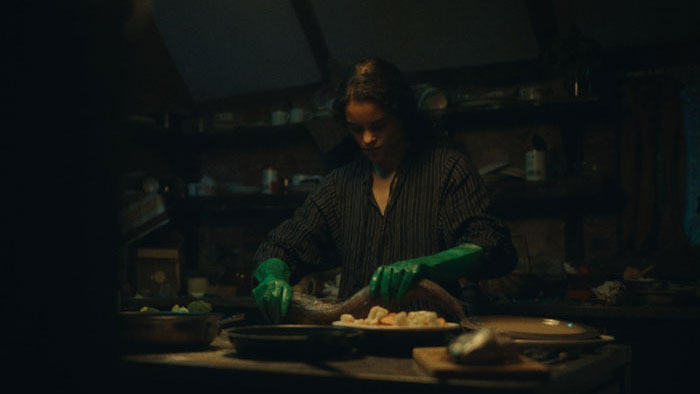
The story and characters come first, with the genre developing around the best way to tell that story.
In Fishbrain, body horror happens to be the perfect language.
Ori’s resentment and rage aren’t simply expressed through dialogue. They’re reflected in the environment around her and increasingly in her own physical experience.
The rotting fish also provide an effective parallel for her relationship with her grandfather. As the fish deteriorate, so too does the relationship at the centre of the film.
It’s an approach that highlights why horror can be such an effective genre for character studies.
It can take something familiar and make it physical.
A feeling of anxiety becomes something growing underneath the skin. Resentment becomes contamination. The responsibilities of care become something you can almost smell, touch and see.
The result is a film where the body horror isn’t separate from the drama.
It is the drama.
Bringing the fish to life
The practical effects were another highlight for me, particularly as someone who has always had a soft spot for practical horror effects.
The creature in Fishbrain was created through a mixture of practical effects and VFX, including puppetry and a suit.
Even the fish themselves involved a combination of practical work and visual effects. The production had around 100 physical fish, while the VFX department expanded on what had been captured.
The result is remarkably convincing and become another part of the film’s atmosphere and storytelling.
That feels particularly important for a film where the horror is so closely connected to the characters.
Working with Chloe Lea and John Henshaw
The film’s central relationship relies heavily on its performances, particularly Chloe Lea and John Henshaw.
Vanderspuy admitted that he hadn’t initially realised Lea was also appearing in A Knight of the Seven Kingdoms, only discovering that after watching the series.
His experience working with her, however, was immediately positive.
He described Lea as incredibly talented and said her performance made it easy to give the actors room to play with their characters and discover what worked.
That approach feels fitting for a film where so much of the emotion exists beneath the surface.
A World Beyond the Short
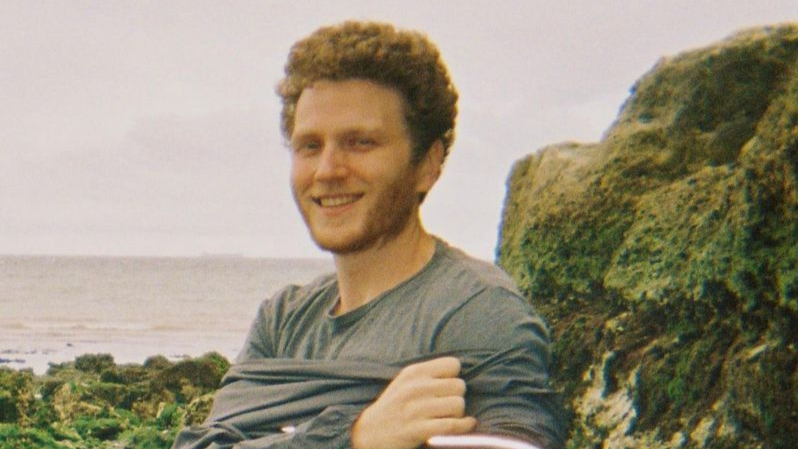
There is clearly much more to the world of Fishbrain than what we see in the short.
Vanderspuy is currently focused on developing Fishbrain into a feature-length film, with a feature based on Recursive Dreams something he’d like to explore further down the line.
For now, however, Fishbrain is the priority.
And there are plenty of questions he wants to explore.
The short deliberately leaves parts of its world open-ended, particularly around the contamination.
Why is it having this effect?
Where did it come from?
What exactly is happening to the fish?
Those questions aren’t necessarily problems that need immediate answers. Instead, they hint at a much larger world sitting behind the story we’re watching.
A feature would give him considerably more room to explore those ideas, and Vanderspuy already has plenty of them.
For now, his focus is firmly on bringing Fishbrain to that next stage. Considering how much of its world remains unexplored, there is plenty of material to work with.
At its core, though, Fishbrain is interested in a feeling that is much more recognisable than its grotesque imagery suggests.
The feeling of being trapped.
The resentment that can build through routine.
The complicated emotions that can come with caring for someone.
Vanderspuy simply takes those feelings and pushes them somewhere much darker.
That’s what makes the horror work.
And if Fishbrain does eventually become the feature Vanderspuy envisions, it could give him the opportunity to dig even deeper into the strange, unsettling world that began with a dream about a coastline covered in dead fish.
Leave a Reply